





Rechercher


Accueil > La Recherche > Axes & Equipes > Matière Molle & Verres > Equipe : Matière Molle > Thème : Interfaces complexes
Thème : Interfaces complexes
Présentation
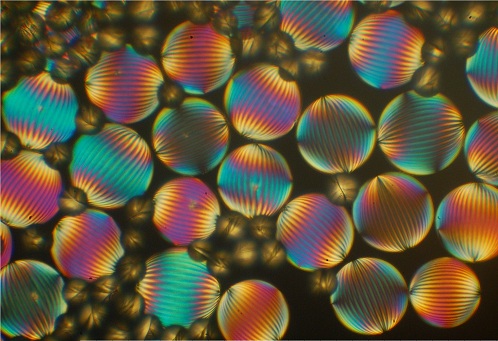
Physics of interfaces have enjoyed a renewed interest thanks to the introduction of new experimental tools and theoretical concepts able to design and rationalize interfaces with large degree of complexity (surfaces with controlled gaussian curvatures, liquid crystal shells), in which colloidal systems show original dynamics. Thanks to lithography and microfluidics, such complex interfaces are designed. In this context, the main results of the group concern : (1) the design and characterization of liquid interfaces presenting complex morphologies and order and their coupling with colloidal particles trapped on them ; and (2) the study of equilibrium and non-equilibrium dynamics taking place at the interface of fluid with different degrees of complexity.
We have expertise with manipulations of particles based on optical tweezers or microfluidic approaches. We have also developed original experimental setups based on optical tools (microscopy, optical trappings, scattering, holography and ellipsometry) allow measuring diffusion coefficients, contact angles and interactions between colloids at these interfaces.
– DYNAMICS OF PASSIVE COLLOIDS AT THE INTERFACES OF SIMPLE FLUIDS,click !
– ACTIVE JANUS COLLOIDS AT THE INTERFACE OF SIMPLE FLUIDS, click !
– COLLOIDS AT THE INTERFACE BETWEEN COMPLEX FLUIDS, click !
– OFF-EQUILIBRIUM MISCIBLE FLUID INTERFACES, click !
– INTERFACE TAILORED MATERIALS, click !
Toutes les productions
Dernières publications

|
Water-Driven Sol–Gel Transition in Native Cellulose/1-Ethyl-3-methylimidazolium Acetate Solutions  Auteur(s): Mohamed Yunus Roshan Akdar, Koch Marcus, Dieudonne-George P., Truzzolillo D., Colby Ralph, Parisi Daniele (Article) Publié: Acs Macro Letters, vol. 13 p.219-226 (2024) |

Dynamics of passive colloids at the interfaces of simple fluids
Dynamics of passive colloids at the interfaces of simple fluids People involved : Blanc C., Nobili M., Stocco A., Gross M., In M., Chollet B.
The interface between two fluids is extremely (...)
Active Janus colloids at the interface of simple fluids
Active Janus colloids at the interface of simple fluids People involved : Stocco A., Blanc C., Nobili M., In M., Chollet B.
Colloids partially coated with platinum are able to perform (...)
Colloids at interface between complex fluids
1. Colloids as probe of surface viscosity at complex fluid interfaces laden with soluble surfactants People involved : M. Nobili, M. In, Stocco A., Ch. Blanc,
We use micro-rheology to assess (...)
Off-Equilibrium miscible fluid Interfaces
Off-Equilibrium miscible fluid Interfaces People involved : D. Truzzolillo, S. Mora, L. Cipelletti
Interfacial tension between immiscible phases is a well-known phenomenon, which manifests (...)
Interface tailored Materials
1. PIC micelles as structuring agents for mesoporous materials
Structured mesoporous materials present surfaces that are used as catalyst support and large porous volumes that are used as drug (...)